

The Problem With Most Side Hustle Lists
Most side hustle content is written by people who either do not have a full time job or have completely forgotten what it feels like to have one.
They recommend things like “start a dropshipping business” or “launch a YouTube channel” as if those are weekend projects. They are not. Dropshipping requires supplier research, product testing, ad spend, customer service, and returns management. A YouTube channel takes 6 to 18 months of consistent uploading before it generates meaningful income for most people. These are not side hustles. They are second businesses that require second-business levels of time and energy.
When you already work 40 to 50 hours a week, commute, cook, sleep, and try to maintain some version of a social life, the math on your available hours is brutal. You have maybe 2 to 3 hours on weekdays and a bit more on weekends. Any side hustle that does not fit inside that reality is not a side hustle for you. It is a fantasy.
This article covers things that actually fit around a full time job. Specifically things that can be started with little to no upfront cost, can generate income within weeks rather than months, and do not require you to build an audience or a brand before you see a single dollar.
Before You Start: The Two Questions That Matter
Before picking anything from this list, answer these two questions honestly.
How many hours per week can you realistically commit without burning out? Not the optimistic number. The real one. If you are already exhausted by Friday, committing to 15 hours of side hustle work every weekend will last about three weeks before you quit. Pick something that fits 5 to 8 hours per week to start. You can always scale up once you have figured out the work.
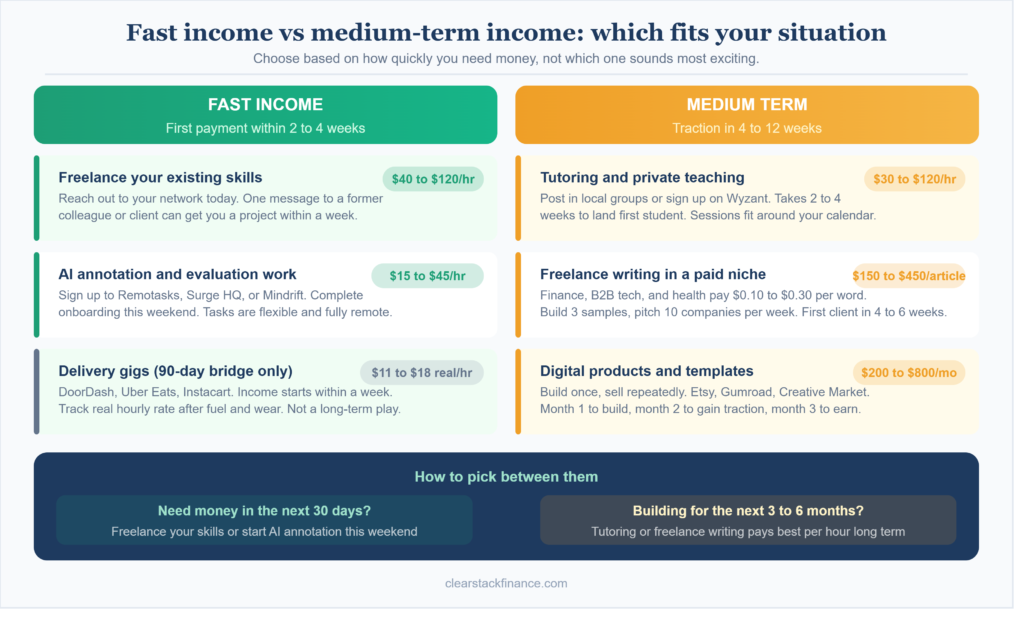
Do you need money fast or are you building for the medium term? Some of the options below can generate income within a week or two. Others take one to three months to get traction. If you are trying to cover a specific expense or build an emergency fund quickly, prioritize the fast ones first. If you have a bit more runway, the medium-term options often pay better per hour once they are established.
The Fast Ones: Income Within 2 to 4 Weeks
Freelance work in your existing skill set
This is the one most people overlook because it feels too obvious. Whatever you do in your day job, there are small businesses, solopreneurs, and startups who need that exact skill but cannot afford a full time hire or an agency.
You are a data analyst. Small businesses need someone to set up their Google Analytics properly and build a basic dashboard. You are a graphic designer. Someone needs a logo for their new side business. You are an accountant. A freelancer needs their quarterly taxes sorted. You are a writer. A company needs three blog posts per month and their in-house person just quit.
The fastest path to your first freelance client is not a profile on Upwork. It is a message to someone in your network. Post on LinkedIn that you are taking on a small number of clients for a specific service. Message three people you know who run small businesses and tell them what you are offering. One email to a former colleague who now runs their own thing. This takes an afternoon and it is faster than any platform.
Platforms are fine for building volume over time but for your first client they are slow and competitive. Start with people who already know you are competent.
AI annotation and evaluation work
This one is genuinely accessible right now in 2025 and 2026 in a way it was not two years ago. Companies building AI models need humans to evaluate outputs, rate responses, write example conversations, flag errors, and label data. The work is flexible, fully remote, and pays reasonably well for tasks that do not require specialized credentials.
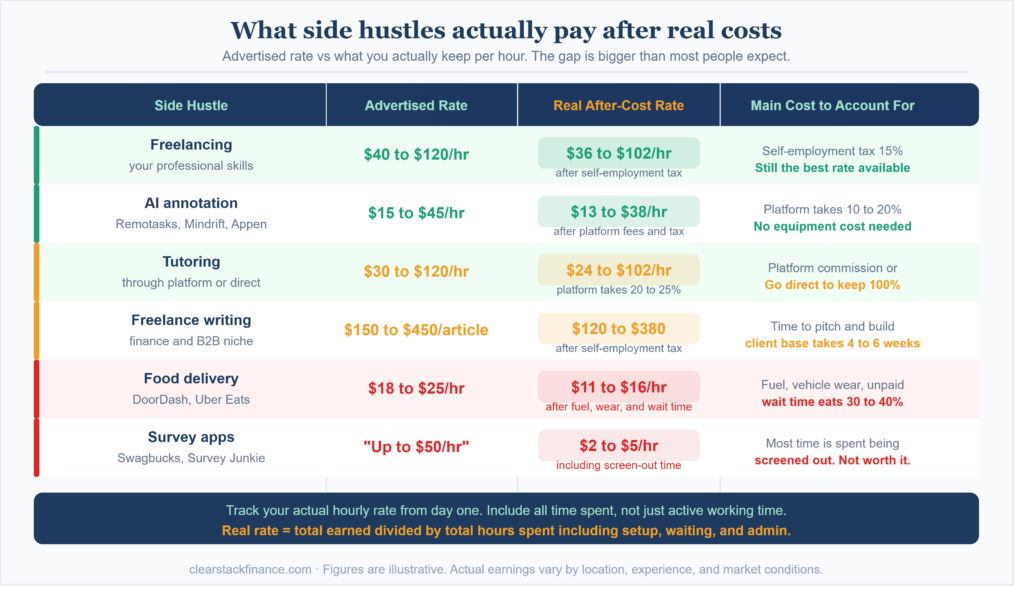
Platforms worth looking at: Remotasks, Appen, Scale AI, Surge HQ, and Mindrift. Each has its own onboarding process and some require a short qualification test. The pay varies from $15 to $45 per hour equivalent depending on the task type and your qualifications. More technical tasks, things requiring domain expertise in areas like science, medicine, law, or coding, pay at the higher end.
The work is not glamorous. It can be repetitive. But it fits into gaps in your schedule, it requires no upfront investment, and the barrier to entry is low compared to most other income sources at this pay rate.
Gig economy work with a time limit
DoorDash, Uber Eats, Instacart, and similar delivery platforms pay quickly and require almost no setup. You sign up, pass a background check, and start earning usually within a week.
The honest case for this: it is not a long-term strategy for most people. The earnings per hour after accounting for vehicle wear, fuel, and the time spent waiting between orders are lower than they appear on the surface. But as a bridge strategy while you set up something better, or as a way to hit a specific savings target within a defined timeframe, it works. Do it for 90 days, hit your goal, then stop.
If you are going to do this, track your actual earnings per hour meticulously including all costs. Lots of people think they are making $20 per hour and are actually making $11 after expenses. Know your real number.
The Medium-Term Ones: Traction in 4 to 12 Weeks
Tutoring and teaching
If you have expertise in any subject that students need help with, tutoring is one of the highest-paying per-hour side hustles available to someone with a full time job. The demand is consistent, the sessions are time-boxed, and you can set your own schedule.
In Canada and the UK, private tutoring for high school students in maths, sciences, and English pays between $30 and $80 per hour depending on the subject and level. In the US, SAT and ACT prep tutoring pays $50 to $120 per hour from established tutors. University level tutoring in specialized subjects pays more.
Platforms like Wyzant, Tutor.com, Superprof, and MyTutor handle client acquisition for a cut of your earnings. Alternatively, post on local Facebook groups, neighborhood apps like Nextdoor, or put a simple notice in school community boards. Parents looking for tutors are not hard to find if you are in the right place.
The time commitment is flexible because sessions are typically one hour, you schedule them around your work calendar, and you are not dependent on a platform’s algorithm to get paid.y
Selling digital products or templates
This one takes longer to set up but has the best income-to-ongoing-time ratio of anything on this list once it is working.
A digital product is something you create once and sell repeatedly. A budget spreadsheet template. A collection of social media graphics for a specific niche. A resume template. A meal planning system. A photography preset pack. A legal document template for freelancers in your country.
Platforms like Gumroad, Etsy (for digital downloads), and Creative Market handle the storefront and payments. You upload the product, set a price, and drive traffic to it. The income is genuinely passive after the initial setup work.
The realistic timeline: a month to create the product properly, another month to get it in front of enough people to start selling consistently. This is not a two-week income source. But at month three or four, if you have a product with real demand, you can be earning $200 to $800 per month from something you built in a few weekends.
The key is picking something with existing demand rather than creating something and hoping people want it. Before building, search for your product idea on Etsy and see if similar products have reviews. If they do, there is demand. If the category is empty, that might mean no one wants it.
Freelance writing and content work
The internet runs on written content and there is consistent demand for people who can write clearly, accurately, and in a specific niche.
Finance, health, technology, legal, and B2B content all pay significantly more than general lifestyle writing. A freelance writer producing finance articles for fintech companies or B2B technology blogs can earn $0.10 to $0.30 per word from established clients, which on a 1,500-word article is $150 to $450 per piece.
Getting started: build 3 to 5 writing samples in your target niche, create a simple portfolio page on a free platform like Journo Portfolio, and begin pitching directly to companies whose blogs you read and whose content you know well enough to match in style and accuracy. Cold pitching to 10 companies per week with a specific, tailored pitch converts better than sending 100 generic emails.
The first client is the hardest. After that, referrals from happy clients tend to fill your schedule faster than platform searching.
What Does Not Work as Well as People Say
Selling on Amazon FBA. The margins have compressed significantly in recent years as the platform has become more competitive and Amazon’s own products compete directly with third-party sellers. The upfront inventory cost, storage fees, and the complexity of product research make this a full business, not a side hustle for someone with 5 to 8 hours per week.
Print on demand. The income ceiling is low unless you have a significant social media audience to drive traffic, and building that audience is itself a long-term project. Without existing traffic, most print on demand stores earn under $50 per month.
Crypto or NFT trading as income. This is speculation, not a side hustle. The people who made money in 2020 and 2021 mostly gave a significant portion of it back by 2022 and 2023. If you want to invest in crypto as a small speculative position in a broader investment portfolio, that is a different conversation. But it is not reliable income.
Surveys and micro-task apps. The effective hourly rate on survey platforms like Swagbucks or Survey Junkie is typically $2 to $5 per hour when you account for the time screening out of surveys you do not qualify for. It is not worth your time if you have other options.
The Burnout Risk Is Real
This part gets left out of most side hustle content and it needs to be said clearly.
Adding 8 to 15 hours of work per week on top of a full time job is physically and mentally taxing. Motivation is high at the start. By month two or three, especially if income has been slower than expected, the exhaustion sets in and the quality of both the side hustle and the day job can suffer.
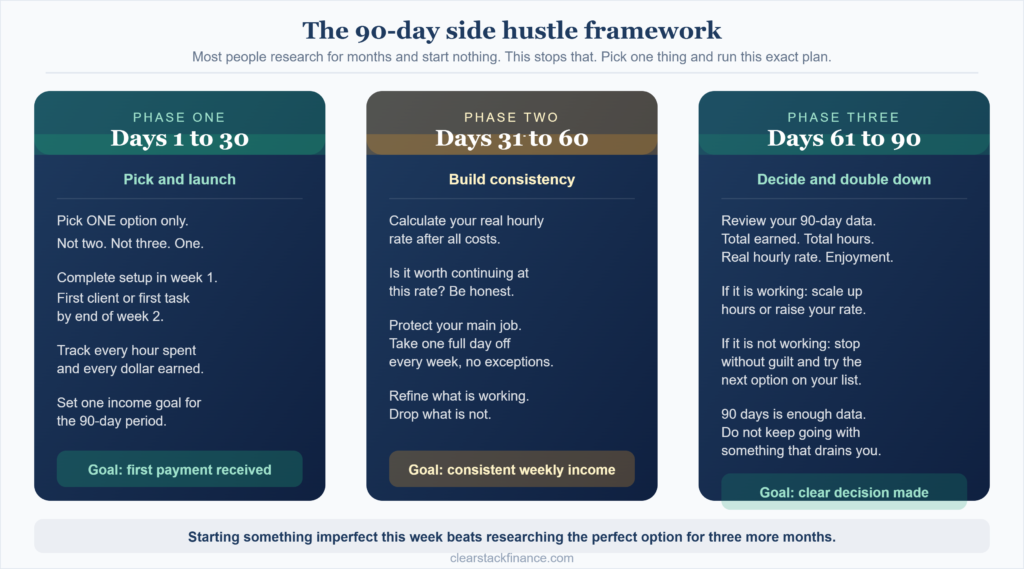
Protect your main income above everything else. Your day job is your financial foundation. If the side hustle is causing you to underperform at work, it is not worth what it is paying you. Keep the hours sustainable. Take a full day off every week where you do not touch the side hustle. Set a clear income goal for the first 90 days and review whether continuing is worth it at the end of that period.
The best side hustles are the ones you can sustain for 12 to 24 months without hating your life. A moderate income consistently earned beats a high income burned out over in three months.
A Simple Way to Pick
Write down your three strongest professional skills. Then write down the constraint that matters most to you right now, either speed of income or income per hour once established.
If you need speed: freelance in your existing skill set and reach out to your network this week. Or start AI annotation work and complete the onboarding process this weekend.
If you want higher income per hour and can wait 4 to 8 weeks: tutoring in your area of expertise or freelance writing in a high-paying niche.
If you want something that scales without trading time for money directly: digital products, but go in with realistic expectations about the timeline.
READ ALSO: The Subscription Trap: How to Cancel, Audit, and Take Back Control of Your Monthly Bills
Pick one. Start it this week. Give it 90 days before deciding whether to continue or switch. Most people make the mistake of researching side hustles for months and starting nothing. Starting something imperfect is better than waiting until you find the perfect option.
Heads up: Income figures mentioned in this article are illustrative and vary significantly based on location, experience, platform, and market conditions. Nothing here is financial or career advice. Always verify current rates and platform terms directly before committing time or money to any of these options.
READ ALSO: How to Cut Your Grocery Bill by $150 a Month Without Eating Differently

Mike is a data analyst based in Niagara Falls, Ontario. He started ClearStack Finance after spending years figuring out personal finance the hard way. No financial jargon, no boring lectures, just practical money advice for people in their 20s and 30s who are still figuring it out.