
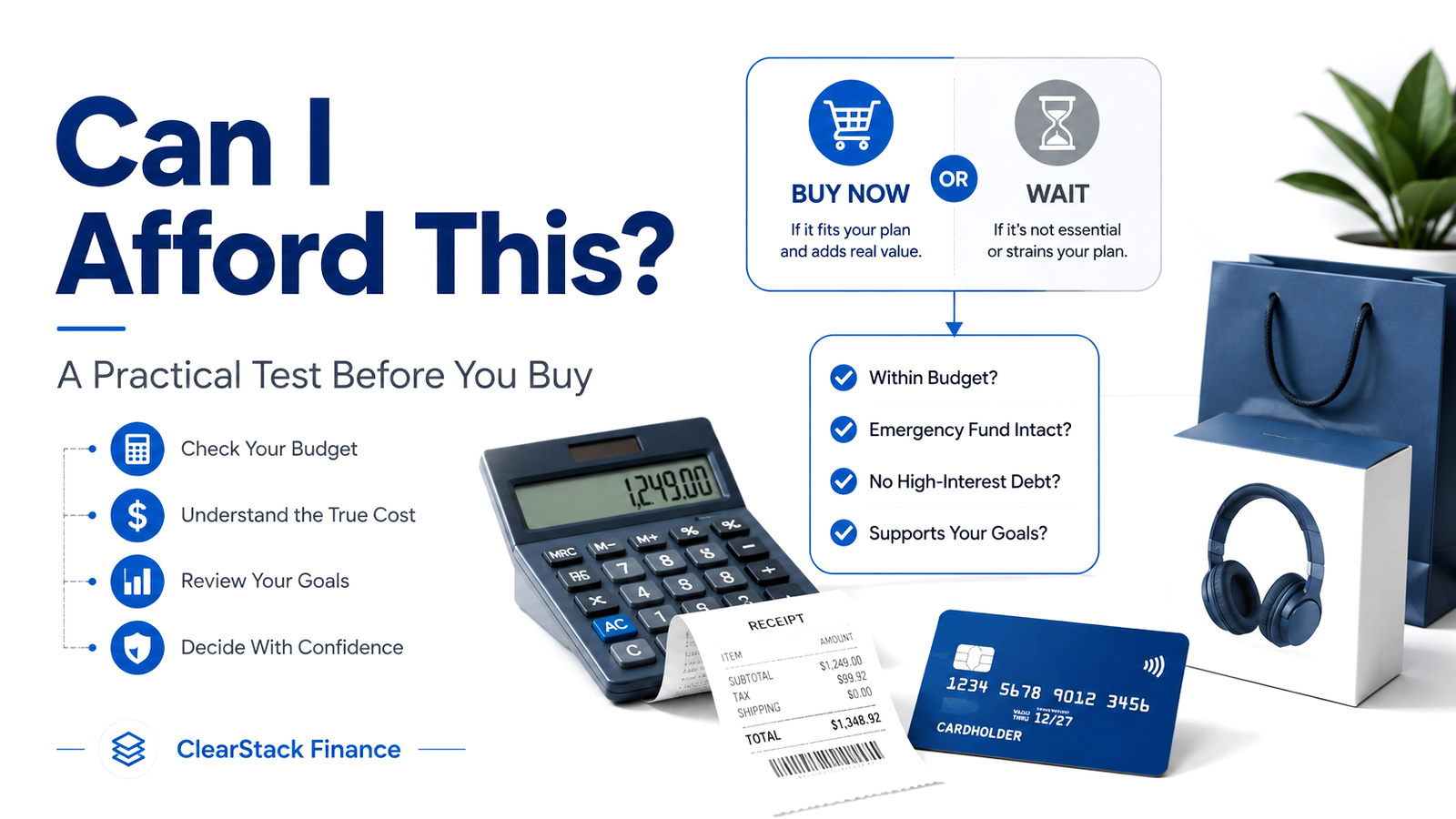
You can afford almost anything on paper if you ignore timing, debt, savings, and the bills that have not arrived yet.
That is where a lot of bad purchases begin. Not because the person is careless. Not because they are bad with money. Usually, it is because they checked the wrong number.
They looked at the bank balance and thought, “I have enough.”
The bank balance can be misleading. It may include money that is already needed for rent, groceries, transport, a phone bill, a credit card payment, or the annoying annual renewal that always seems to arrive at the worst time. A purchase can look affordable at 2 p.m. and become stressful two weeks later.
The better question is not “Do I have the money right now?”
The better question is “Can this purchase fit into my real month without damaging something more important?”
That is the purpose of a proper affordability check. It slows the decision down just enough to see the purchase in context.
What does “afford” actually mean?
People use the word “afford” in different ways.
For some people, it means they have enough money in their account today. For others, it means they can make the monthly payment. For others, it means they can buy the item without using debt.
Those are different standards, and they do not lead to the same decision.
A useful definition is more practical:
You can afford a purchase when you can pay for it without missing bills, relying on new debt you cannot clear, weakening your basic savings, or creating pressure in the next few weeks.
This definition is stricter than “the payment went through.” That is intentional. A card payment going through only proves the transaction was approved. It does not prove the purchase was financially comfortable.
Affordability is about the whole month, not the moment at checkout.
The mistake with checking only your bank balance
Your bank balance tells you what is available in the account. It does not tell you what is already spoken for.
Imagine someone has $1,200 in their account and wants to buy a $450 phone. At first, that looks fine. The money is there.
But if rent is due in five days, groceries are not bought yet, the phone bill is pending, and the person still wants to save $150 that month, the picture changes. The purchase may still be possible, but it is no longer a simple yes.
This is why people sometimes feel confused after buying something they technically had the money for. The account was positive. The purchase was not huge. Nothing seemed reckless. Then the month tightened.
The missing piece was timing.
A good affordability test treats upcoming bills as real, even before they leave the account. It also treats savings goals as real, not as money that can be raided every time something tempting appears.
The four checks before a purchase
Before buying something that is not part of your normal spending, it helps to run four checks.
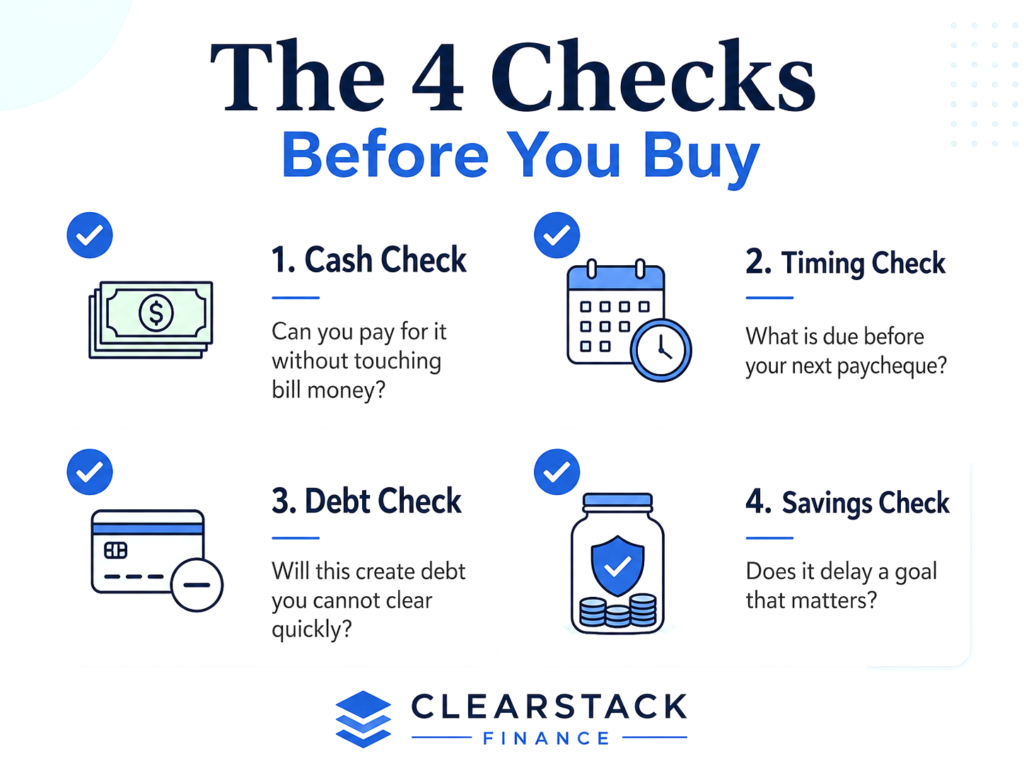
1. The cash check
Can you pay for it without using money needed for bills, food, transport, rent, debt minimums, or other necessary expenses?
If yes, the purchase may be affordable.
If no, the answer is probably not “never.” It may simply be “not this month.” That distinction matters. Delaying a purchase is not the same as denying yourself forever. Sometimes the smartest choice is moving it to a month where it does not compete with basic costs.
2. The timing check
What bills are due before your next paycheque?
This is where a purchase can become risky even when the account balance looks healthy. If the next seven to fourteen days are packed with payments, a purchase that seems fine today may create pressure quickly.
Timing is especially important if you are paid weekly, biweekly, or on irregular hours. A monthly view can hide short-term cash gaps. You may earn enough over the month, but still have the wrong expenses arriving before the next pay.
3. The debt check
Will this purchase create credit card debt, buy now pay later payments, overdraft use, or another balance you cannot clear quickly?
Debt is not automatically bad in every situation. A planned purchase with a clear repayment path is different from a purchase that gets pushed forward because the money is not there.
The problem is when the monthly payment makes the item feel smaller than it is. A $900 purchase can feel harmless when it is split into smaller payments. But the full cost still exists. It has only been spread across future months.
Those future months already have their own bills.
4. The savings check
Will buying this delay a savings goal that matters?
Sometimes the answer is yes, and that may be acceptable. You might choose to delay a holiday fund because your laptop broke and you need one for work. That is a reasonable trade-off.
But the trade-off should be visible. If a purchase delays your emergency fund, moving fund, tuition fund, debt payoff plan, or rent buffer, name that cost clearly before buying.
A purchase is easier to judge when you know what it is replacing.
Needs, wants, and the awkward middle
The usual advice is to separate needs from wants. That is useful, but real life is not always that tidy.
Rent is a need. Groceries are a need. A designer jacket is usually a want. Those are simple.
But many purchases sit in the middle.
A phone can be a need if your current one is broken and you need it for work, banking, school, transport, or family contact. A phone can also be a want if your current one works and the new one is mainly about preference.
A car repair may be necessary if you rely on the car to get to work. A car upgrade may be a want if the current car still does its job.
A course may support your earning ability. It may also be an expensive impulse if you are unlikely to finish it.
This is why the better question is not only “Is it a need or a want?”
The better question is “What happens if I wait?”
If waiting creates a real problem, the purchase may be more necessary. If waiting mainly creates annoyance, the purchase may be less urgent. That does not mean you cannot buy it. It just changes how hard the purchase has to pass the affordability test.
The 30-day version and the 24-hour version
Not every purchase needs the same waiting period.
For small purchases, a 24-hour pause can be enough. If you still want it the next day and it fits your budget, fine.
For larger purchases, use a longer pause. A 7-day or 30-day wait can reveal whether the item is still useful or whether it was mostly a reaction to boredom, stress, comparison, or a good advert.
The point of waiting is not to remove all enjoyment from spending. It is to separate a real preference from a passing mood.
If you still want the item after waiting, and the numbers work, the purchase is easier to make without guilt.
How to judge a monthly payment
Monthly payments need extra attention because they make expensive items feel manageable.
A $42 payment sounds easier than a $1,008 purchase. But if that payment lasts 24 months, the real decision is not “Can I afford $42?”
The real decision is “Do I want this payment sitting in my budget for two years?”
That is a different question.
Before accepting a monthly payment, check three things:
- The total cost over the full term
- Any interest, fees, or penalties
- Whether the payment reduces room for savings, debt payoff, or future bills
Also check how many monthly payments you already have. One small payment may not hurt. Several small payments can make a budget feel tight even when none of them looks serious alone.
This is how people end up with a budget full of tiny obligations. Each one made sense at the time. Together, they remove flexibility.
The “hours worked” test
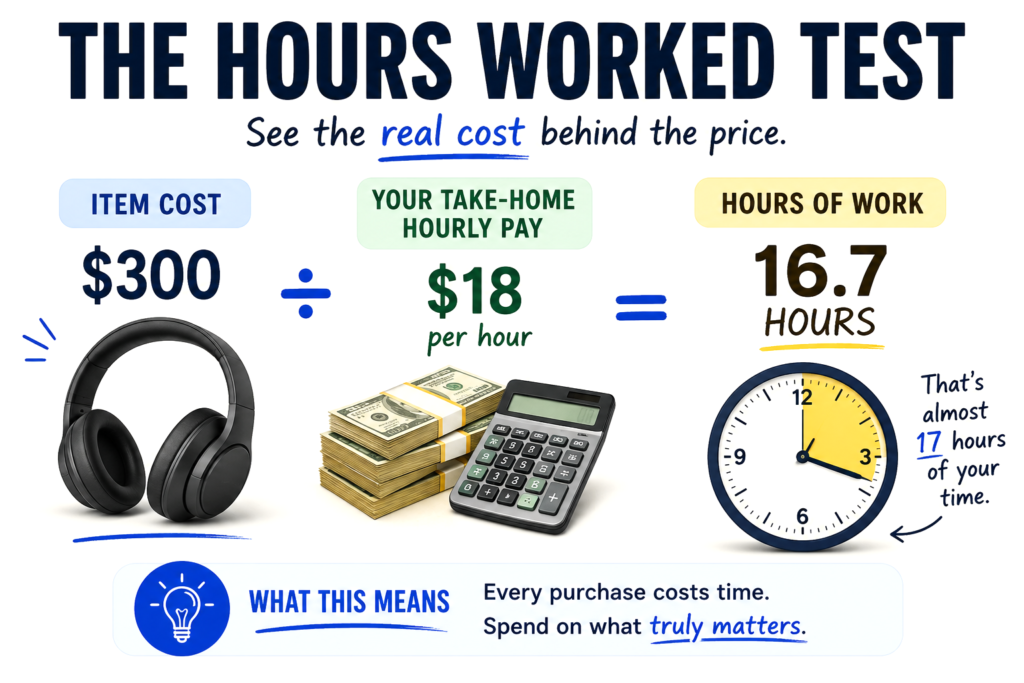
One useful way to judge a purchase is to convert it into hours of work.
Use your take-home hourly rate, not your gross rate. If you earn $20 an hour before tax, your real take-home may be lower. If you are salaried, divide your monthly take-home pay by your usual monthly work hours.
Then divide the purchase cost by that take-home hourly number.
If something costs $300 and you take home about $18 an hour, the item costs roughly 17 hours of work.
That does not automatically mean you should not buy it. It simply gives the price a clearer shape. Some purchases are worth many hours of work. Others look less appealing when you see the time behind them.
This test is especially useful for wants, upgrades, gadgets, fashion, trips, and convenience spending. It makes the cost harder to ignore.
The “next month” test
A purchase is not only about this month. It can affect next month too.
Ask one question before buying:
Will I still be dealing with this purchase next month?
If the answer is no, and the money fits this month, the decision is simpler.
If the answer is yes, because of financing, credit card repayment, buy now pay later payments, or reduced savings, the purchase needs more thought.
Future-you should not be the person who quietly pays for every decision present-you did not want to examine.
When buying it now may make sense
This article is not arguing that every purchase should be delayed or avoided.
Buying now can make sense when the purchase prevents a bigger cost, supports work or school, replaces something necessary, or improves safety. A laptop needed for paid work is different from a laptop bought because the old one feels boring. A car repair needed for commuting is different from a cosmetic upgrade.
Buying now can also make sense when you have already saved for the item. If the money was set aside for that purpose, using it is not a failure. That is what the money was for.
The goal is not to feel bad every time you spend. The goal is to know which spending is planned and which spending is quietly stealing from something else.
When waiting is probably the better answer
Waiting is usually better when the purchase depends on credit you cannot clear, when it would reduce your rent or bill money, or when you are already behind on another obligation.
Waiting is also worth considering when the purchase is mainly driven by urgency created by a sale. A discount is only useful if the item already made sense at the normal price. Buying something unnecessary at 30% off is still spending 70% of the price.
Another warning sign is secrecy. If you feel the need to hide the purchase from your budget, partner, family, or even from yourself, it may be worth pausing.
That does not mean the purchase is wrong. It means the decision deserves more attention than a quick checkout.
A simple affordability score
When the calculator for this article is live, it will turn these checks into a simple result. For now, you can use the same logic manually.
A purchase is usually in a safer range when:
- You can pay for it without missing bills
- You do not need to carry credit card debt to buy it
- Your emergency savings are not being drained for a non-emergency
- Your savings goals still make progress
- The purchase does not create a monthly payment you will resent later
- You would still buy it after waiting 24 hours or more
A purchase is more risky when:
- You are using rent, grocery, or bill money
- You are relying on income that has not arrived yet
- You are adding debt without a clear repayment plan
- You are already short before the next paycheque
- The purchase delays an important goal without you choosing that trade-off clearly
This kind of scoring is not perfect. It is not meant to be. It is meant to interrupt the automatic purchase long enough for the real cost to appear.
The best question before buying
The best question is not “Can I afford this?” in a vague sense.
Ask it more specifically:
Can I buy this and still be okay before my next paycheque?
Then ask:
Can I buy this and still be okay next month?
If both answers are yes, the purchase is probably on firmer ground.
If one answer is no, the purchase may need to wait, shrink, or be planned differently.
If both answers are no, the item is not affordable right now, even if the payment would technically go through.
Final thought
Affordability is not about never buying things you want. That is not realistic, and for most people it is not necessary.
Affordability is about making sure one purchase does not quietly damage the rest of your money.
A good purchase should fit into your real life, not just your available balance at checkout. It should leave your bills covered, your basic savings intact, and your next few weeks manageable.
If a purchase passes that test, you can make it with more confidence. If it does not, waiting is not failure. It is just the decision that keeps the rest of your month from becoming harder than it needs to be.
Heads up: this article is for informational purposes only and does not constitute financial advice. I am not a licensed financial advisor. Please consult a qualified professional before making any financial decisions.

Mike is a data analyst based in Niagara Falls, Ontario. He started ClearStack Finance after spending years figuring out personal finance the hard way. No financial jargon, no boring lectures, just practical money advice for people in their 20s and 30s who are still figuring it out.